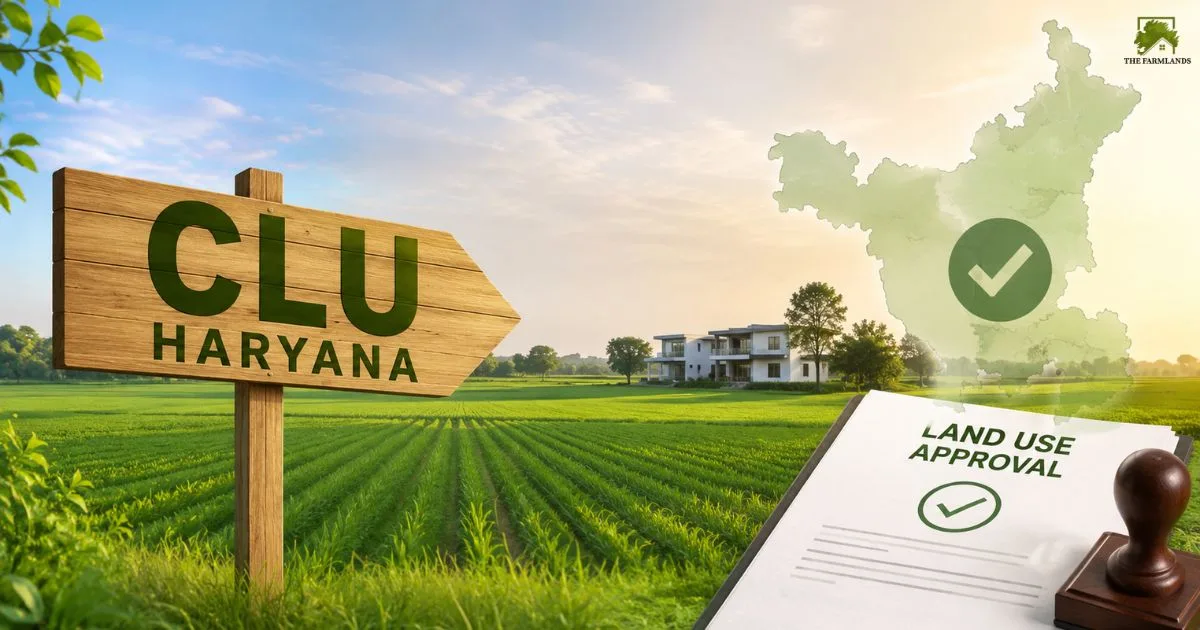
Buying land in Haryana is not just about checking the sale deed, location, and price. One of the most important things every buyer should understand is CLU, which stands for Change of Land Use.
In simple words, CLU is the official permission required when land is used for a purpose different from its existing or approved land use. For example, if agricultural land is to be used for residential, commercial, industrial, institutional, warehouse, hospitality, or similar non-agricultural purposes, CLU approval may be required depending on the land location, zoning, and applicable rules.
For buyers, this matters because a land parcel can have clear ownership documents but still may not be legally usable for the purpose the buyer has in mind. That is why CLU should be checked carefully before buying land in Haryana, especially if the land is being marketed for farmhouse, plotted development, commercial use, or future construction.
What Does CLU Mean in Haryana?
CLU means permission to change the use of land from one category to another. In Haryana, this is mainly governed by town planning and development laws. In controlled areas, the key law is the Punjab Scheduled Roads and Controlled Areas Restriction of Unregulated Development Act, 1963, along with the Punjab Scheduled Roads and Controlled Areas Restriction of Unregulated Development Rules, 1965.
Under these rules, a person who wants to change the existing land use in a controlled area for residential, industrial, commercial, or other building purposes is generally required to apply for CLU permission. The application process, documents, scrutiny fee, conversion charges, and conditions are covered in the rules.
Inside municipal limits, the process may come under the Urban Local Bodies framework. The Urban Local Bodies Department, Haryana mentions that CLU cases in municipal areas are processed under the relevant provisions of the Haryana Municipal Act and Haryana Municipal Corporation Act.
This means the correct CLU route depends on where the land is located: controlled area, municipal area, licensed colony, or another regulated planning zone.
Why CLU Matters for Land Buyers
Many land buyers make the mistake of checking only ownership papers. While title verification is important, it is not enough. Land-use permission is a separate issue.
A land parcel may have:
-
A registered sale deed
-
Mutation in revenue records
-
Physical possession
-
Existing boundary or construction
-
Road access
But still, the intended use may not be legally permitted.
For example, agricultural land may not automatically be used for commercial activity, plotted colony development, banquet hall, hotel, warehouse, or residential construction. Depending on the location and planning rules, the buyer may need CLU, a licence, building plan approval, environmental clearance, or other permissions.
This is why CLU should be seen as a planning approval, not a title document. It does not prove ownership. It only confirms that the land use has been permitted by the competent authority, subject to conditions.
When Is CLU Required in Haryana?
CLU is generally required when land is being used for a purpose different from the legally permitted or existing land use. Common examples include:
-
Agricultural land being used for residential construction
-
Agricultural land being converted for commercial activity
-
Land being used for warehouses, factories, petrol pumps, institutions, hospitals, hotels, or banquet halls
-
Land being developed as plotted residential or commercial colonies
-
Land being used in a way that does not match the development plan or zoning rules
However, every case depends on the location and category of land. In Haryana, land may fall under a controlled area, municipal area, urban development area, village area, or other notified planning zone. That is why buyers should not rely only on verbal claims such as “CLU ho jayega” or “ye land already approved hai.”
The safest approach is to verify the land-use status directly from official documents and competent authorities.
CLU vs Colony Licence: What Is the Difference?
This is one of the most important points for buyers.
CLU and colony licence are not always the same thing.
A CLU may allow a specific change in land use. But if the land is being divided into plots, sold as a colony, or developed as a planned layout, a separate licence may be required under the Haryana Development and Regulation of Urban Areas Act, 1975 and related rules.
This matters because some sellers use the word “approved” very loosely. A buyer should ask:
-
Is there a CLU order?
-
Is there a colony licence, if required?
-
Is the licence valid or expired?
-
Are layout plans approved?
-
Are development charges paid?
-
Is there any restriction on sale, transfer, or registration?
For a land buyer, this difference can directly affect future construction, resale, loan eligibility, and registration safety.
Documents Buyers Should Check Before Buying Land
Before buying land in Haryana, especially if the land is being presented as suitable for farmhouse, residential, commercial, or development use, buyers should ask for both revenue documents and planning documents.
Revenue and ownership documents
-
Sale deed and previous chain of title
-
Latest jamabandi
-
Mutation or intkal record
-
Khasra and khatauni details
-
Aks-sajra or site map
-
Possession status
-
Encumbrance or litigation check
Planning and CLU-related documents
-
CLU permission/order, if applicable
-
Approved land-use or zoning details
-
Development plan/master plan status
-
Approved layout plan, if any
-
Building plan approval, if applicable
-
NOC from road authority, irrigation department, or other departments where required
-
Proof of payment of conversion charges and development charges
-
Valid licence, if the project is a colony or plotted development
-
Completion or occupation certificate, if construction already exists
The ULB Haryana CLU checklist also mentions documents such as jamabandi, mutation/intkal, aks-sajra/site plan, land schedule, land-utilization statement, registered sale deed or lease deed, and relevant NOCs in municipal-limit CLU cases.
CLU Application Process in Haryana: A Simple Overview
The exact process depends on the land location and the authority involved, but a typical CLU process includes the following steps:
-
Identify the land clearly
The applicant must know the exact khasra numbers, area, village, tehsil, district, and ownership details. -
Check zoning and development plan
The proposed use must be checked against the applicable master plan, controlled area plan, municipal plan, or zoning regulations. -
Prepare application and documents
Under the 1965 Rules, applications may require forms, title documents, survey/site plan, and prescribed scrutiny fee. -
Submit application to the competent authority
The authority may be the Town and Country Planning Department, Urban Local Bodies authority, or another designated body depending on the area. -
Department scrutiny
Authorities may check title, access, land-use compatibility, environmental issues, development plan conformity, and required NOCs. -
Payment of charges
The applicant may have to pay scrutiny fee, conversion charges, development charges, and other applicable dues. -
Issue of CLU permission or refusal
If approved, the CLU permission usually comes with conditions, validity period, and compliance requirements. -
Further approvals before construction
CLU does not automatically mean construction can start. Building plan approval, environmental clearance, fire NOC, pollution clearance, or other approvals may still be needed depending on the project.
Fees and Charges: What Buyers Should Know
The official rules mention a scrutiny fee of Rs. 10 per sq. m. for certain CLU applications. However, this is only a small part of the total cost.
The larger cost is usually the conversion charge, which can vary based on:
-
Location
-
Land-use category
-
Road frontage
-
Potential zone
-
Proposed use
-
FAR and project type
-
Whether the land is in a high-potential area like Gurugram, Faridabad, Panchkula, Sonipat, Panipat, or other notified zones
The 1965 Rules include schedules for conversion charges for different land-use categories such as residential, commercial, industrial, institutional, warehouses, recreational use, and other categories.
Buyers should also check for:
-
External development charges
-
Infrastructure development charges
-
Location premium, where applicable
-
Interest or penalty on unpaid dues
-
Renewal fees, if permission has expired
-
Pending government demand notices
A seller may show a CLU approval but still have unpaid dues. Therefore, buyers should ask for payment receipts, demand notices, and no-dues status wherever possible.
Common CLU Risks Buyers Should Avoid
1. Buying land only on verbal assurance
Statements like “CLU approved hai” or “approval process mein hai” should not be accepted without documents. Always ask for the actual order and verify it.
2. Assuming sale deed means legal land use
A sale deed only records transfer of ownership. It does not automatically permit a change in land use.
3. Confusing CLU with building approval
CLU may allow a land-use change, but construction may still require building plan approval and other permissions.
4. Ignoring zoning and master plan restrictions
If land is reserved for road widening, green belt, public use, sector road, controlled area restrictions, or environmental protection, CLU may not be possible or may be highly restricted.
5. Not checking environmental restrictions
Some areas may be affected by Aravalli, PLPA, forest, eco-sensitive, wildlife, floodplain, or environmental clearance rules. CLU approval does not override these restrictions.
6. Buying into an unlicensed plotted project
If land is being sold as plots in a larger layout, a colony licence may be required. Without proper licensing, buyers may face registration, construction, and resale issues.
7. Not checking validity period
CLU approvals and licences may have validity periods. Expired permissions, non-renewed licences, or incomplete compliance can create serious problems later.
Buyer Due Diligence Checklist for CLU in Haryana
Before buying land, use this checklist:
-
Confirm exact khasra numbers and land area
-
Check ownership chain and latest revenue records
-
Confirm whether the land falls in a controlled area, municipal area, or licensed colony
-
Check the master plan or development plan land-use category
-
Ask whether CLU is required for your intended use
-
Ask for the CLU order, if already approved
-
Verify whether a colony licence is required
-
Check all payment receipts for conversion charges and development charges
-
Check whether any approval has expired
-
Verify NOCs from road, irrigation, electricity, pollution, fire, or other departments where required
-
Check if the land is affected by road widening, green belt, sector plan, environmental restriction, or litigation
-
Consult a Haryana real estate lawyer and local planner before final payment
Is CLU Needed for Farmhouse or Farmland Use?
This depends on the exact nature of use.
If land is used for agriculture, plantation, organic farming, or similar agricultural activity, CLU may not be required in the same way as commercial or urban development use. But if the buyer wants to build a farmhouse, run a commercial resort, create a plotted colony, operate a banquet facility, or use the land for non-agricultural commercial activity, permissions may be required.
For this reason, buyers should understand the difference between farmland ownership, farmhouse construction, and commercial development. You can also read our related guides on Can You Build a Farmhouse on Agricultural Land in Haryana? and Farmland in Haryana: Locations, Prices & Investment Guide (2026).
If your main goal is organic farming, peaceful weekend use, a second-home lifestyle, or long-term land investment, it is better to choose land where the project structure, location, access, and documentation are clear from the beginning.
Why CLU Awareness Is Important for NCR Land Buyers
Haryana has become a major focus area for land buyers because of its connectivity with Delhi NCR, Noida, Faridabad, Gurugram, Palwal, and upcoming infrastructure corridors. But higher demand also means buyers must be more careful.
Land near highways, expressways, golf courses, airports, and fast-growing urban corridors may look attractive, but its legal use must still be checked. A buyer should not invest only because an area is “upcoming.” The better question is: is the land legally suitable for the purpose I am buying it for?
For buyers exploring farmland or farmhouse-style investments around Delhi NCR, our guides on Farmhouse Policy in Haryana and FarmLand in Noida can help you understand location, use, and investment-related factors in more detail.
The Farmlands: Premium Organic Farmland with Clear Purpose
At The Farmlands, the focus is on premium organic farmland ownership for people who want greenery, calm surroundings, and long-term land value near Delhi NCR.
The Farmlands offers 1 Acre Premium Organic Farmland at Maozmabad, Faridabad, Haryana, located opposite the Noida International Golf Course, Sector 151A, with close proximity to the Noida Expressway. It is designed for buyers who want land for organic farming, a weekend getaway, a second-home lifestyle, or a peaceful nature-connected investment.
Because land buying involves both emotional and financial decisions, documentation and location clarity matter. The Farmlands is positioned for buyers who want the experience of open green land without disconnecting from NCR’s growth corridor.
Conclusion
CLU in Haryana is not just a technical government term. It is one of the most important legal checks for land buyers. Before buying land, buyers should confirm whether the intended use is permitted, whether CLU or licence is required, whether all charges are paid, and whether the land is free from planning or environmental restrictions.
A safe land purchase is not only about finding the right location. It is about buying land that is legally suitable for the purpose you have in mind.
Note: This blog is for informational purposes only and should not be treated as legal advice. Before buying or developing any farmhouse property, consult a qualified real estate lawyer, architect and planning consultant.