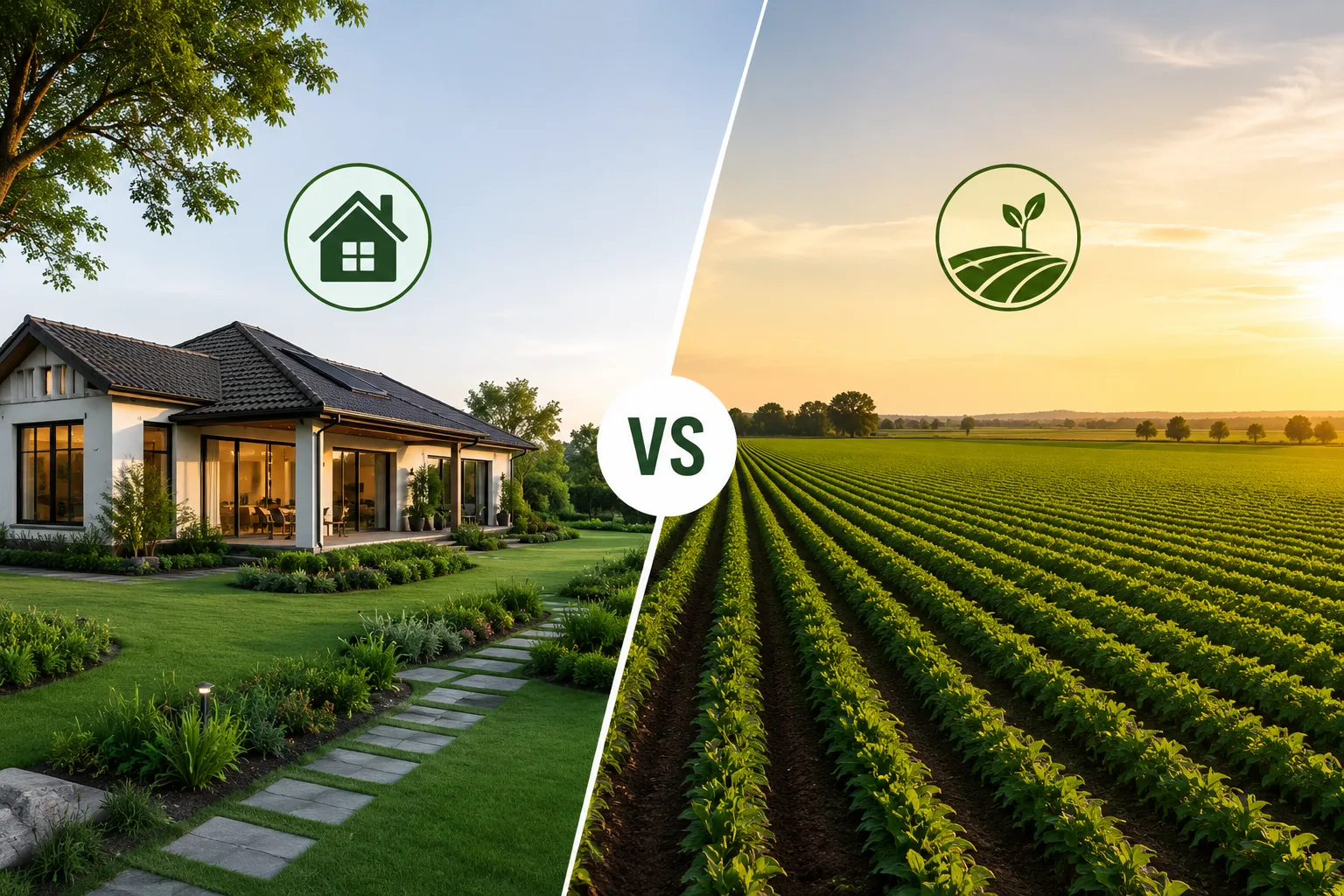
For many buyers in Delhi NCR, Noida, Faridabad, and Haryana, the words farmhouse and farmland are often used together. A person may say they want to “buy a farmhouse,” while another may say they are looking for “farmland near Noida” or “agricultural land near Delhi.” But from an investor’s point of view, these two are not the same.
A farmhouse is mainly understood as a built structure or a second-home style property located on rural or agricultural land. Farmland, on the other hand, is the land itself usually purchased for agricultural use, organic farming, long-term land ownership, future lifestyle planning, or a farmhouse after following the required rules.
This difference matters because the legal status, return potential, maintenance cost, usage rights, liquidity, and risk profile can be very different. If you are planning to invest in land near Delhi NCR, understanding the difference between farmhouse and farmland can help you make a more informed decision.
What Is Farmland?
Farmland refers to land that is primarily meant for agricultural use. It may be used for crop cultivation, plantations, organic farming, orchards, horticulture, dairy-related activities, or other permitted agricultural purposes depending on local rules.
From an investment perspective, farmland is usually a land-first asset. Its value is driven by factors such as:
- Location and road connectivity
- Soil quality and water availability
- Size and shape of the plot
- Legal title and land-use status
- Proximity to growing urban corridors
- Infrastructure development nearby
- Long-term scarcity of usable land
In India, agricultural land rules can vary from state to state. For example, land-use conversion, farmhouse construction, and permissions are usually regulated at the state level. In Haryana, buyers should understand policies related to agricultural zones, farmhouse permissions, and Change of Land Use before making a decision. You can read more about this in our detailed guide on CLU in Haryana Explained.
For investors, farmland is often attractive because it gives ownership of a real, limited asset. Unlike apartments or constructed properties, land does not physically depreciate in the same way. However, farmland also requires careful due diligence because the land-use category, title, access road, and permitted development rules matter a lot.
What Is a Farmhouse?
A farmhouse is generally a residential or leisure structure built on rural or agricultural land. It may be used as a weekend home, second home, family retreat, private residence, or lifestyle property.
However, the important point is this: a farmhouse is not just about building a house on any agricultural land. Construction rules depend on local land-use regulations. In Haryana, farmhouse development in agricultural zones may require specific compliance with relevant policies, including area norms, permissible construction, and other conditions. Haryana’s Town and Country Planning Department has issued policy guidance for eco-friendly farmhouses in agricultural zones, which shows that farmhouse development is a regulated activity, not just a design choice. Source: Town and Country Planning Department, Haryana – Eco Friendly Farmhouse Policy.
For a buyer, a farmhouse is usually a lifestyle-led asset. Its value depends not only on land but also on the quality of construction, landscape, approach road, security, privacy, maintenance, and the lifestyle experience it offers.
If you are specifically interested in the legal side of building a farmhouse, you may also find our blog on Can You Build a Farmhouse on Agricultural Land in Haryana? useful.
Farmhouse vs Farmland: Key Difference
The simplest way to understand the difference is this:
Farmland is the base asset. A farmhouse is a structure or lifestyle use created on that land, subject to rules.
| Factor | Farmland | Farmhouse |
|---|---|---|
| Main nature | Land-first asset | House/lifestyle-led asset |
| Primary use | Agriculture, organic farming, plantation, long-term land ownership | Weekend home, second home, rural residence, leisure use |
| Value driver | Land location, size, access, future growth, agricultural potential | Land + construction quality + lifestyle appeal |
| Maintenance | Usually lower if used simply for farming or plantation | Higher due to building, landscaping, utilities, staff, repairs |
| Legal focus | Land title, agricultural status, access, land-use rules | Building permission, construction limits, CLU/farmhouse policy compliance |
| Return profile | Long-term appreciation, possible agricultural/lease use | Lifestyle value, rental/hospitality potential where legally permitted, resale appeal |
| Investor type | Land investors, long-term wealth holders, organic farming/lifestyle buyers | Lifestyle buyers, second-home seekers, premium rural residence buyers |
For many investors, farmland is the more flexible starting point because it gives control over the land. A farmhouse can be developed later if the land and regulations allow it. But buying a ready farmhouse may be useful for buyers who want immediate use and do not want to go through development planning themselves.
Why Investors Should Not Confuse the Two
Many real estate buyers make the mistake of comparing a farmhouse and farmland only on price. But the right comparison should be based on legal use, income potential, risk, and future exit value.
For example, if you buy farmland, your return is mostly connected to land appreciation, organic farming use, and the growth of the surrounding location. If you buy a farmhouse, your return also depends on construction quality, maintenance cost, lifestyle demand, and whether the farmhouse use is legally permitted.
This is especially important in regions like Haryana and the Delhi NCR belt, where demand for farmhouses, second homes, and green weekend properties is growing. Buyers often search for a farmhouse near Delhi, farmhouse near Noida, or farmland in Haryana, but each option needs a different investment lens.
Investment Returns: Which One Performs Better?
There is no single answer because both assets create value differently.
Farmland Returns
Farmland generally creates value through long-term appreciation. As cities expand and infrastructure improves, well-located land near growth corridors can become more desirable. In India, demand for land near expressways, airports, industrial corridors, and major urban centres has increased because buyers want a mix of accessibility and open space.
Farmland can also offer practical use. Owners may use it for organic farming, orchard development, weekend farming, plantations, or leasing depending on the land and local regulations. The income may not always be high in the early years, but the main appeal is long-term land ownership.
India’s agricultural land market is not as standardized as apartment or commercial property markets, but land remains a strong emotional and financial asset for many Indian families. We have also covered this broader mindset in our blog: Why Owning Land Still Feels Like Power in Modern India.
Farmhouse Returns
A farmhouse can provide lifestyle value immediately. It can be used as a weekend retreat, family getaway, second home, or private green space away from crowded urban areas. In some locations, farmhouses may also have rental or hospitality potential, but this depends heavily on local permissions.
This is where investors must be careful. If a buyer assumes that a farmhouse can be used for parties, events, commercial stays, or banquet-style income without checking permissions, the investment can become risky. Haryana’s eco-friendly farmhouse policy specifically restricts misuse such as banquet or party-hall operation. Source: TCP Haryana Eco Friendly Farmhouse Policy.
So, a farmhouse may give higher lifestyle satisfaction, but it usually comes with higher maintenance and regulatory responsibility.
Legal and Land-Use Difference
Legal status is one of the most important differences between farmhouse and farmland.
Farmland is usually classified for agricultural use. A farmhouse, however, introduces a residential or built-use element. That means the owner must check whether farmhouse construction is permitted, how much construction is allowed, whether CLU is required, and whether the proposed use is allowed under local rules.
In Haryana, Change of Land Use is an important topic because using agricultural land for non-agricultural or built purposes may require formal approval. Our detailed guide on Farmhouse Policy in Haryana explains this in more detail.
Investors should check:
- Is the land legally recorded as agricultural land?
- Is the title clear and transferable?
- Is there proper road access?
- Is farmhouse construction allowed on this land?
- Is CLU required?
- What construction area is permitted?
- Are commercial uses restricted?
- Are electricity, water, and fencing available?
- Does the project or land meet local compliance requirements?
For legal safety, buyers should always verify land documents with a qualified legal advisor before making a purchase decision.
Risk Difference Between Farmhouse and Farmland
Both farmhouse and farmland investments have risks, but the type of risk is different.
Risks in Farmland Investment
The main risks in farmland investment include unclear title, poor access, uncertain land-use rules, low liquidity, water issues, and overpaying for land without checking future potential. Investors should also avoid buying only on the basis of verbal promises about future development.
A good farmland investment should be supported by proper documentation, clear location advantage, usable land size, access road, and realistic long-term demand.
Risks in Farmhouse Investment
A farmhouse carries all the risks of farmland plus additional risks related to construction, maintenance, permissions, and usage. If the building is not legally permitted or if the buyer plans to use it commercially without approval, the risk increases.
Common farmhouse risks include:
- High maintenance cost
- Construction quality issues
- Illegal or excessive construction
- Misuse for commercial activities
- Poor resale market if location is weak
- Higher cost of utilities and staff
- Lower flexibility compared to raw land
This is why many investors prefer buying well-planned farmland first and then developing a farmhouse only after understanding the rules.
Liquidity: Which Is Easier to Sell?
Liquidity depends on location, pricing, documentation, and buyer demand.
A well-located farmhouse may attract lifestyle buyers faster because it offers immediate use. However, if the farmhouse is very expensive, poorly maintained, or legally unclear, the buyer pool becomes smaller.
Farmland may take longer to sell because buyers usually do deeper due diligence. But good farmland in a strong growth location can remain attractive because it offers flexibility. A buyer can use it for farming, plantation, a future farmhouse, or long-term land holding.
For Delhi NCR investors, the location advantage becomes very important. Land around Noida, Faridabad, and nearby expressway-connected belts is being watched closely because buyers want open green spaces without being completely disconnected from the city. You can explore related location-based reading here: Farmland in Noida, Farmland in Delhi, and Haryana Real Estate.
Maintenance and Holding Cost
This is one of the most practical differences.
Farmland generally has lower holding cost if it is kept simple. The owner may need fencing, basic maintenance, plantation care, water management, or farming support. But there is no major building to maintain unless the owner constructs one.
A farmhouse has a higher holding cost because it includes:
- Building repairs
- Landscaping
- Security
- Electricity and water systems
- Staff or caretaker cost
- Cleaning and upkeep
- Furniture and interiors
- Periodic renovation
For investors who want a low-maintenance long-term asset, farmland may be more suitable. For buyers who want immediate lifestyle usage, a farmhouse may justify the higher cost.
Which Is Better for Long-Term Investors?
For long-term investors, farmland often offers a stronger foundation because the value is attached to land ownership. A good parcel of farmland in a growing location can remain useful even if the buyer’s plans change.
For example, one buyer may use the land for organic farming. Another may develop a private farmhouse after following rules. Another may hold it for long-term appreciation. This flexibility makes farmland attractive.
A farmhouse, on the other hand, is better for investors who already know they want a built weekend home or second home. It is more lifestyle-focused and may offer immediate enjoyment, but it also requires more capital and maintenance.
A simple decision rule:
- Choose farmland if your priority is long-term land ownership, flexibility, organic farming, and appreciation.
- Choose farmhouse if your priority is immediate lifestyle use, weekend living, and a ready private retreat.
- Choose a planned farmland project if you want land ownership with clearer infrastructure, access, services, and future farmhouse potential.
Due Diligence Checklist Before Buying
Before investing in either farmland or farmhouse, check the following:
- Title and ownership documents
Confirm the seller has clear ownership and the land is free from disputes. - Land-use status
Check whether the land is agricultural, residential, converted, or under any controlled area rules. - Access road
A good road is important for both use and resale. - CLU or farmhouse permission
If you plan to build a farmhouse, check whether permission or CLU is required. - Permitted construction area
Do not assume you can build anything of any size. Local rules may limit construction. - Electricity and water availability
These are essential for farming, farmhouse living, and long-term usability. - Location growth
Study nearby highways, expressways, airports, commercial zones, and urban expansion. - Maintenance plan
Understand how the land or farmhouse will be maintained after purchase. - Exit market
Think about who may buy the asset from you in the future. - Legal review
Always get documents checked by a property lawyer before final payment.
Farmhouse vs Farmland: Which One Should You Choose?
The right choice depends on your purpose.
If you want a peaceful weekend space near Delhi NCR, a farmhouse may sound attractive. But if you want a more flexible and long-term asset, farmland can be a better starting point. You can always plan a farmhouse later if the land, rules, and permissions allow it.
For many modern investors, the best approach is not to think of it as farmhouse vs farmland, but as farmland first, farmhouse later. This allows you to secure the land, understand the location, use it for organic farming or plantation, and then develop a farmhouse in a planned and compliant way.
This is especially relevant for buyers looking at land near Noida, Faridabad, and Haryana, where the demand for green second-home spaces is rising due to urban crowding, pollution, heatwaves, and lifestyle fatigue. We have discussed this trend in detail in our blogs on Best Places Near Delhi NCR to Escape Heatwave and Delhi NCR Heatwave Investment Farmland.
The Farmlands: 1 Acre Premium Organic Farmland Near Noida-Faridabad Growth Belt
If you are looking for farmland that gives you both investment value and lifestyle potential, The Farmlands offers 1 Acre Premium Organic Farmland in Maozmabad, Faridabad, Haryana.
The project is positioned for buyers who want open green land close to Delhi NCR, without disconnecting from important urban infrastructure. The Farmlands is located opposite Noida International Golf Course, Sector 151A, with close proximity to Noida Expressway and growing connectivity around the Noida-Faridabad belt.
At The Farmlands, the focus is on land ownership, organic farming, peaceful weekend use, and future farmhouse potential. The project is suitable for buyers who want:
- 1 Acre premium organic farmland
- A second-home or weekend getaway option
- Organic farming and plantation potential
- A green escape near Delhi NCR
- Long-term land ownership in a developing corridor
- A planned farmland environment with essential infrastructure
- Government electricity availability
For investors comparing farmhouse vs farmland, The Farmlands offers the land-first advantage. You own a real parcel of farmland and can plan its use according to your lifestyle and long-term goals, subject to applicable rules and approvals.
Conclusion
Farmhouse and farmland may look similar from the outside, but they are very different investment assets. Farmland is mainly about land ownership, agricultural use, flexibility, and long-term appreciation. A farmhouse is more about built lifestyle value, immediate use, and higher maintenance.
For serious investors, the safer approach is to first understand the land. Check the title, location, access, land-use status, permissions, and future growth potential. A farmhouse can add lifestyle value, but the strength of the investment usually starts with the quality of the farmland beneath it.
If your goal is long-term land ownership with the option of organic farming, weekend living, and a future farmhouse, premium farmland can be a more balanced and flexible choice.